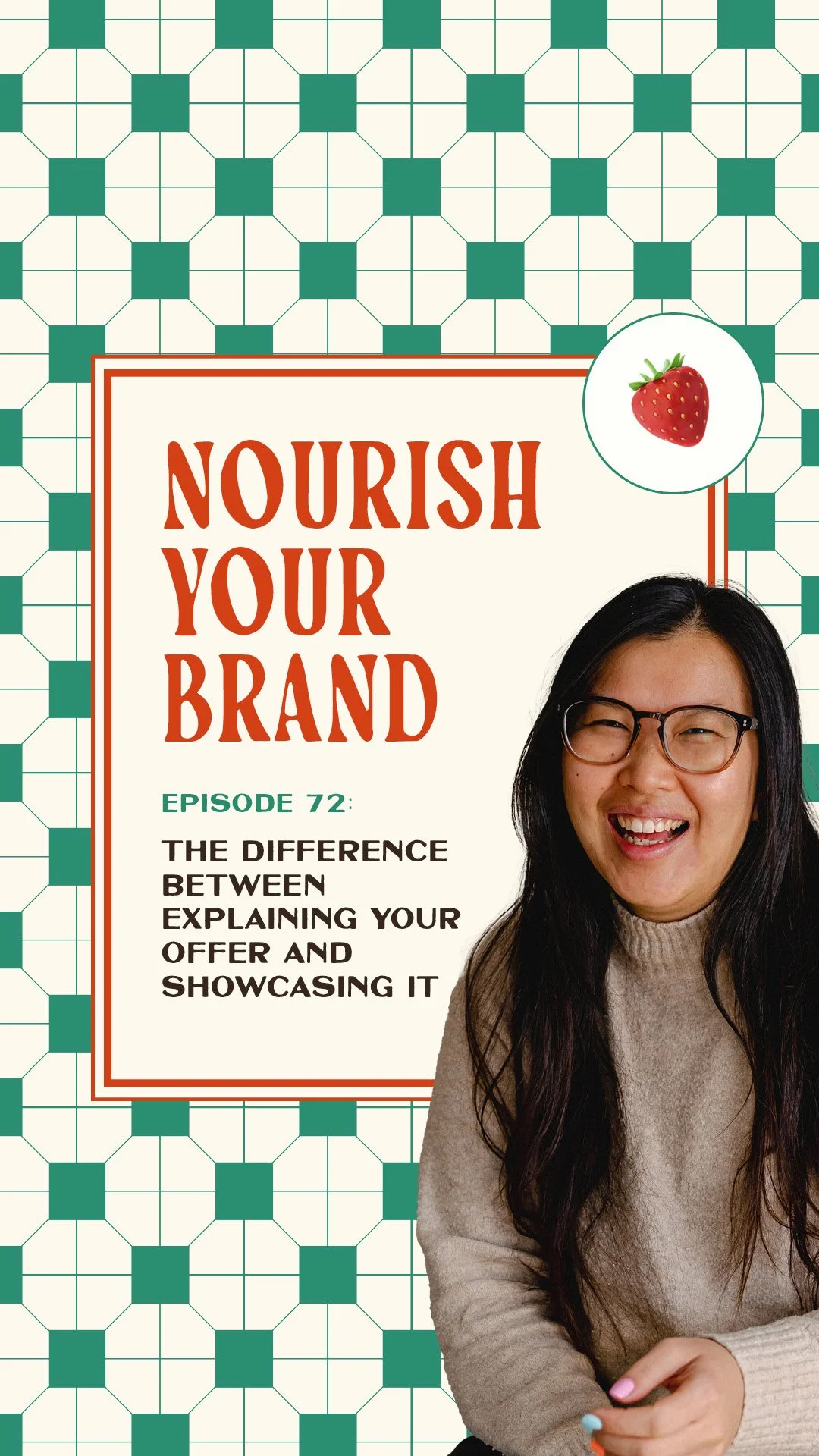
Ep 72. Showcase Your Offer, Don't Explain It
Nourish Your Brand · Episode 72
Picture a supermarket with two promo stands selling the same jam. At the first, someone holds up the jar and tells you everything, the nutrition, the small-batch process, the single farm, how carefully they sterilise the jars.
At the second, there's toast in the toaster, little scones, a wedge of cheese, tiny spoons, and they're spreading the jam onto everything and handing out samples.
People stop, taste, and put the jar in their basket. Same jam, completely different experience.
That's what's happening with your offer. Let's get into it.
Why we default to explaining
Explaining feels productive, it's tangible, something to tick off. Another paragraph, another FAQ, more content. It feels like moving forward, but none of it changes how your offer lands for the person on the other side.
The deeper reason is confidence: we over-explain because we don't quite trust the offer to do its job without a lot of words wrapped around it. "If I just clarify one more thing, they'll get it." But you're overcompensating, crowding the offer. I say this with zero judgement, I've added paragraph after paragraph to a sales page thinking it would clarify.
Spoiler: it made it harder to find the meat of what I was actually offering. More words doesn't mean a clearer offer. (This is the flip side of Episode 64, naming and explaining isn't enough)
Showcasing is a stance, not a design move
Two people can have the exact same colours and fonts, and one is still explaining while the other is showcasing. The difference is how you present, the energy you bring, whether you overwhelm people with words or let your offer exist and be absorbed. Three shifts make up that stance.
From translator to host. Stop being the person holding up the jar with a spiel. Become the second stand, toasting the bread, slicing the cheese, handing out samples. Your offer becomes the centrepiece and you're the host, not the explanation. The host is generous and having fun; the explainer is working hard to convince.
From content to scene. Content is the words, what you get, the nuts and bolts, the story of how you made it. Useful, but the second stand presents a scene, the warm toast. For your offer that means helping people imagine what it's like to experience it, the transformation, how it feels to be taken through it. People add more to feel substantial; building the scene is what actually creates substance.
From caveats to conviction. The first jam person says "it's nice, you might like it if you're into raspberry, it's not really for everyone." You've already wandered off. The second says "try this, it's the best jam we make, we put it on everything." Go back and count how often you say "I'm just trying to", "it could be", "maybe this is for you." You're adding doubt, and clients feel it. The thing they buy first is your conviction. Drop the "justs" and disclaimers and the offer stands on its own.
Why this matters
People don't buy because they read every line or understand every detail. They buy because they felt the offer was right for them first. Feelings come first, always, and feelings need somewhere to land. Explanation crowds that space, so people tense up.
That's why the same offer can feel like a yes from one brand and an "I don't know" from another. (And feeling it before they read it is exactly the perception point in Episode 57)
Three moves to try
Show before you explain. Open with the scene, what it's like inside the offer, not caveats. The spec is fine, it just doesn't go first.
Cut the caveats. Find one sentence where you've softened your offer and take it out. Read it back, notice how it stands taller. Do another next week.
Stop translating. Mention your offer without explaining what it is in the same breath, like it already exists in people's heads (the way you'd say "Christmas"). It feels like leaving a sentence unfinished, but that discomfort is trust building, and it sparks curiosity.
Ask yourself this week
Are you the first jam stand or the second?
How many caveats creep into how you talk about your offer?
Do you lead with the feeling, or a features list?
Where to go from here
If you want your offer to feel like the second jam stand, a whole experience people want to try, that's exactly why I built the Offer Oven. It's my 7-day sprint where I brand your offer from the ground up and build a whole visual world around it, the toast, the scones, the cheese, so the scene pulls people in and you don't have to stand there explaining.
Book a free Brand Pairing call and let's chat.
Related episodes
Ep 64: Why naming your offer isn't enough
Ep 70: Why nobody can remember what you sell
Ep 57: Why your offer feels too expensive (even when it's not)
Resources mentioned
Offer Oven – my 7-day sprint to build a visual world around your offer so it showcases itself
Brand Pairing call – a free 15-minute fit chat
Come say hi on Instagram: @studiocoya
Here's More…
Why doesn't explaining my offer more sell it? Because people buy on feeling first, and explanation crowds the space where that feeling lands. More words usually make your offer harder to grasp, not clearer. Showcasing lets the offer breathe.
What's the difference between explaining and showcasing an offer? Explaining is holding up the jar and listing facts. Showcasing is setting the scene so people experience it, leading with the feeling and transformation, with conviction rather than caveats. It's a stance, not just a design choice.
How do I start showcasing my offer? Show before you explain, cut your caveats one at a time, and reference your offer like it already exists in people's heads. Building the whole scene around it is what the Offer Oven does.
About the host
I'm Aiza, the brand chef behind Studio Coya, a branding studio with a food-themed twist. I help established coaches, creators and service providers brand their signature offers so their best work looks as good as it actually is, and sells like hotcakes.